calendar_month
Tahun:
location_on
Lokasi Asli: Khwarazm / Uzbekistan
menu_book
Halaman: 0 Hlm
The original foundational text (matn) is Talkhis al-Miftah by Jalaluddin al-Qazwini. This text was later expounded upon with a commentary (sharh) by the eminent scholar Imam Sa'd al-Din al-Taftazani (d. 792 AH / 1390 CE) entitled Mukhtasar al-Ma'ani. The writing of this commentary was completed by al-Taftazani in the region of Khwarazm (located in present-day Central Asia/Uzbekistan) in the mid-8th century AH.
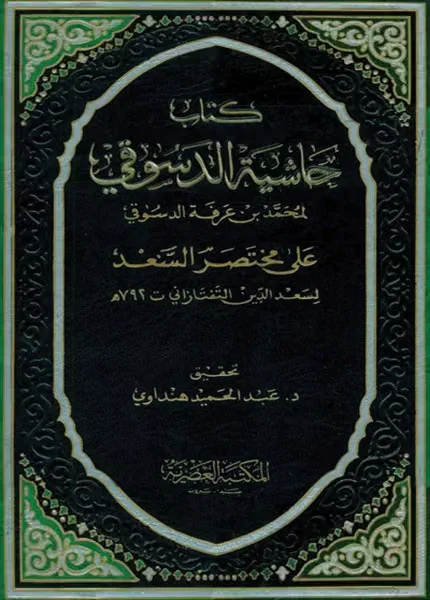
The most renowned Hashiyah Mukhtasar al-Ma'ani (supercommentary) in the Islamic academic tradition was written by:
- Imam Muhammad ibn 'Arafah al-Desouqi (d. 1230 AH / 1815 CE), which was authored and taught in Cairo, Egypt (Al-Azhar University).
- Another prominent alternative version is Hashiyah al-Khata'i by Nizam al-Din al-Khata'i.
This work stands as one of the most authoritative masterpieces and forms a core mandatory curriculum across traditional Islamic seminaries (pesantren) and universities (including Al-Azhar in Egypt) for studying Ilm al-Balaghas (advanced Arabic Literature, Rhetoric, and Stylistics). The Arabic of the Qur'an and Hadith possesses an inimitably miraculous beauty, and this treatise systematically analyzes it through 3 primary branches:
- Ilm al-Ma'ani (علم المعاني): Examines sentence construction in Arabic to ensure alignment with situational context, requirements, and the speaker's intent toward the listener (contextual semantics).
- Ilm al-Bayan (علم البيان): Explores various modes and methods of expressing a single idea through diverse phrasing, such as simile (Tashbih), trope/metaphor (Majaz and Isti'arah), and subtle allusion (Kinayah).
- Ilm al-Badi' (علم البديع): Focuses on rhetorical embellishments, encompassing auditory harmony (Saj', Jinas) as well as conceptual beauty (Tibaq or antithesis, and Muqabalah).